So… I recently found out there’s a rumour going around that I’m shutting down TLMartin Ltd and becoming a takeaway delivery driver.
Now, I’ll be honest, that’s a new one.
I’ve heard plenty over the years:
- “IT just presses buttons”
- “It’ll be fine without backups”
- “We’ll sort security later”
But “Tristan’s packing it all in to deliver kebabs”?
That’s a creative leap.
Why do rumours like this even start?
In business, especially in local networks, people talk.
Sometimes it’s harmless. Sometimes it’s misunderstanding.
And sometimes… it’s something else.
Let’s just say:
If someone has time to make things up about another business, they’re probably not as busy as they’d like to be.
The funny side (because you have to laugh)
Now obviously, I took this very seriously…
Sat down, updated my CV, reflected on my life choices…and thought, “Yes. This is it. This is the moment I pivot into takeaway logistics.”
So naturally… I “applied”.
Shockingly, it didn’t work out.
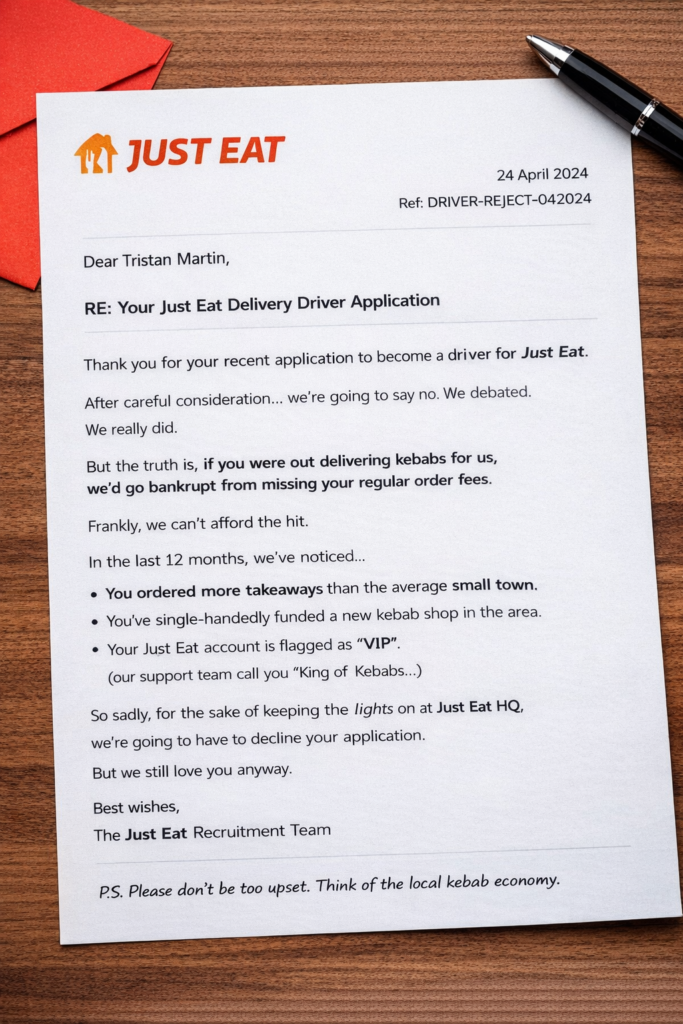
Apparently I’m more valuable as a customer than an employee. Something about “financial risk” and “ordering frequency”.
Devastating.
The serious bit (this actually matters)
Jokes aside, this kind of situation highlights something important:
People believe things far too easily.
And not just in business rumours.
We see it all the time in IT:
- Scam emails
- Fake invoices
- “Your account will be closed unless you act now”
- And my personal favourite…
“Facebook is going to start charging you unless you copy and paste this post”
(Yes, that one is still doing the rounds…)
The common problem
Whether it’s:
- A rumour about a business
- A dodgy email
- Or a viral Facebook post
The question should always be the same:
“Does that actually sound right?”
Because most of the time… if you stop and think for 5 seconds… It doesn’t.
Why this matters for your business
This isn’t just about avoiding a bit of embarrassment.
It’s about:
- Protecting your business
- Protecting your data
- Avoiding costly mistakes
Because the same instinct that makes someone believe a rumour… is the one that clicks a phishing link.
Here’s the reality
I’m not going anywhere.
If anything, we’re continuing to help more businesses get their IT sorted properly
Because that’s what we do.
Final Thought:
If you hear something about a business…or see something online that wants you to act quickly…
Pause.
Ask yourself:
“Does that actually sound right?”
Because whether it’s:
- A rumour about someone’s business
- A phishing email
- Or a Facebook post trying to scare you into copying and pasting it
They all rely on the same thing:
You not stopping to think.
And if you’re ever unsure? Ask someone who knows.
(Preferably someone who’s still very much in IT…and not out delivering kebabs.)
TL;DR:
- There’s a rumour I’ve quit IT to deliver takeaways
- I haven’t (shocking, I know)
- I did not actually apply for a delivery job… despite what this blog might suggest
- People believe things too quickly, whether it’s rumours or scams
- A simple question solves most of it: “Does that actually sound right?”