
One unsolicited email. Thirty businesses. One angry reply. And a lesson in cybersecurity that everyone should understand.
We’ve all received them.
Emails from people we’ve never heard of, offering services we’ve never asked for, from businesses we have absolutely no intention of working with.
App development. Website design. SEO services. Marketing packages. The occasional promise to make your business millions of pounds overnight.
Most of us recognise them for what they are: Spam.
And what do we do? Delete them and get on with our day.
Unfortunately, not everybody does. And sometimes, the reaction to a spam email can cause more problems than the original message.
We recently had a perfect example of this, when one of our IT support clients forwarded us an email conversation and asked a simple question:
“Is this a scam?” (The perfect action)
What followed was a rather interesting lesson in spam, data protection, emotional manipulation, email etiquette and why the Reply All button can be a dangerous thing.
Let’s explain.
It Started With an Innocent-Looking Marketing Email
Our client was one of approximately 30 businesses copied into an unsolicited marketing email.
The sender claimed to represent a technology company based in the UK, with over 100 IT experts and more than 1,200 completed projects.
They were offering mobile application development services. Android apps. iPhone apps. Custom software. The usual collection of services you’d expect from a digital development company.
Nothing particularly unusual about that, businesses receive cold marketing emails every day.
But there were several things about this particular email that immediately stood out.
Firstly, the email came from a free Outlook.com address. Now, there’s nothing inherently wrong with using Outlook.com. Millions of people do, but if you’re claiming to represent a substantial technology company with over 100 employees, you’d generally expect an email address using the company’s own domain.
Secondly, the name of the person sending the email didn’t match the name signing it. Apparently, our sender was having something of an identity crisis. Again, not proof of a scam, but hardly a reassuring first impression.
Thirdly, and perhaps most importantly, the email had approximately 30 businesses openly copied into the CC field. Not BCC. CC.
That means every recipient could see the other recipients’ email addresses.
And that is where our story really begins.
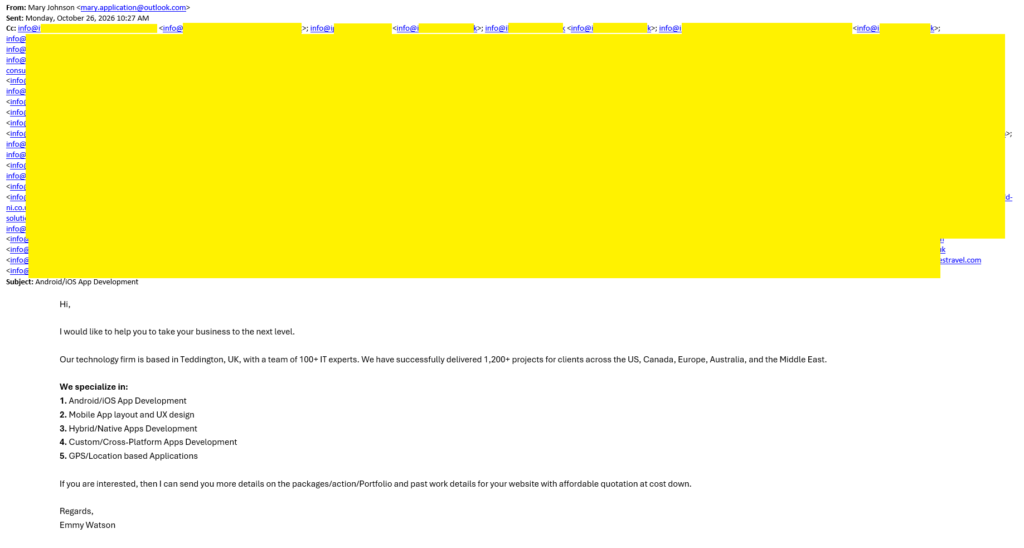
Caption: The original unsolicited marketing email, showing the large number of recipients openly copied into the message. Email addresses have been obscured to protect the businesses involved.
The Alphabetical Clue
Something else caught our attention.
The visible email addresses were remarkably similar in one particular way. They largely began with the same letter. The businesses’ domain names also appeared to follow the same alphabetical pattern. Now, that’s quite a coincidence if you’re personally selecting 30 businesses you genuinely believe would benefit from your services, but it makes considerably more sense if someone has collected email addresses from websites or online directories, arranged them alphabetically and divided them into batches.
This is commonly known as email scraping. Software can collect publicly available email addresses from websites, directories and other online sources. Those addresses can then be placed into lists and used for mass marketing.
Not every business that collects publicly available contact information is necessarily breaking the law. The legality depends on how the information is collected, who is contacted, what the marketing involves and whether the relevant data protection and electronic marketing rules are followed.
However, collecting a load of addresses and sending an identical email to everyone, with all the addresses visible, is hardly a shining example of professional marketing. Particularly when you’re supposedly a technology company.
You’d hope someone in a business with 100 IT experts might know the difference between CC and BCC.
Scam or Spam? There’s a Difference
At this stage, we need to be fair.
Was this definitely a scam? We don’t know.
It could have been a genuine developer using particularly poor marketing techniques.
It could have been someone working overseas, claiming to operate from the UK.
It could have been a freelancer trying to drum up business.
Or it could have been someone looking for potential victims.
The email alone doesn’t prove which.
What we do know is that it was unsolicited bulk marketing, sent in an unprofessional manner.
And for our client, who had never requested these services, the appropriate response was straightforward.
Ignore it. Delete it. Move on.
But the sender wasn’t finished.
The Next Day: The Follow-Up
Less than 24 hours later, another email arrived.
Same sender. Same collection of recipients. Same subject.
Only this time, the message suggested they were following up about the app development and could share pricing and examples.
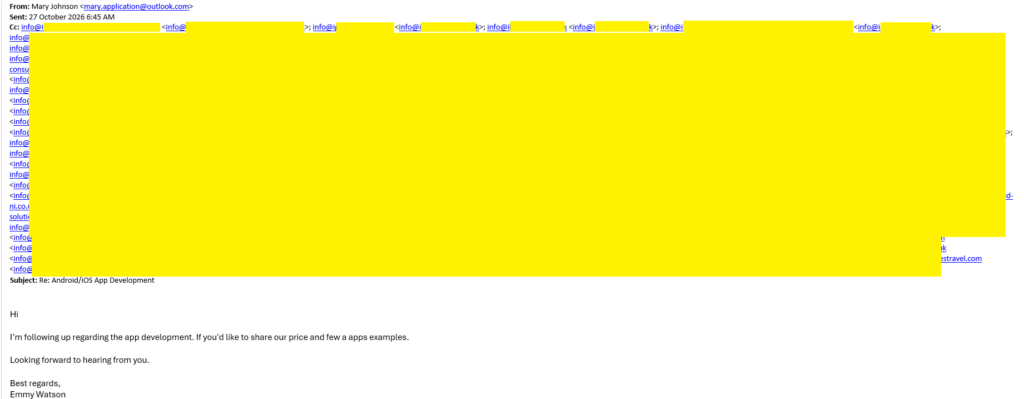
Caption: The follow-up arrived less than 24 hours later, again copying the same group of businesses.
Now, I have to give the sender some credit here. They remembered to follow up. That’s something plenty of legitimate businesses, including my own at times, could be better at!
But there’s a problem. The wording gives the impression that there’s already been some sort of conversation. That the recipient has shown an interest. That they’re simply continuing a discussion. Except there hasn’t been a discussion. Nobody has asked for prices. Nobody has requested a portfolio. It’s just another unsolicited message and while that might simply be clumsy sales language, it’s also a technique that can be used to encourage people to engage.
Because sometimes, the objective isn’t necessarily to sell you something immediately. Sometimes, it’s to find out who is listening.
Fishing for a Response
Imagine standing beside a lake with a fishing rod. You don’t know whether there are any fish in there. So you cast your line. You wait. Perhaps you get a bite. Now you know there’s something worth fishing for.
Unsolicited emails can work in a similar way. A sender distributes messages to hundreds or thousands of addresses. Some don’t exist. Some belong to businesses that have closed. Some are never monitored. Others belong to real people who actively read their emails and some of those people respond.
A response can tell the sender that the address is active, that somebody reads the messages, and potentially that the person is willing to engage.
That information can be valuable.
It’s also important to recognise that legitimate businesses use engagement information in their marketing. They may remove inactive contacts, identify interested prospects and clean up their databases. The difference is how responsibly that information is collected and used.
For someone operating a malicious campaign, a response might help identify a more promising target.
And that brings us to the third email.
The one our client actually forwarded to us.
Enter the Angry Recipient
One of the businesses copied into the original message had clearly had enough. They responded with a complaint about data protection and demanded removal from the mailing list.
Fair enough, you might think. Nobody likes unwanted marketing and exposing email addresses to dozens of strangers can raise legitimate data protection concerns.
But here’s the problem.
They didn’t just reply to the sender.
They clicked Reply All.
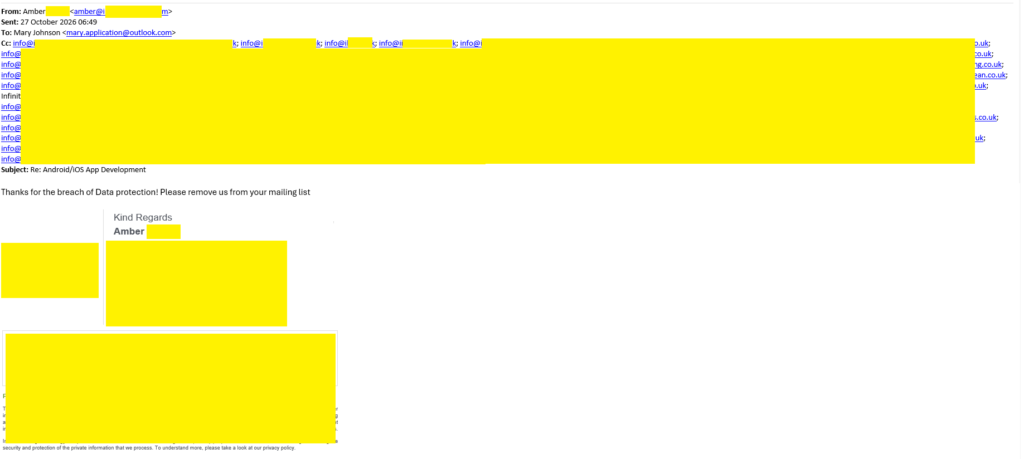
Caption: One frustrated recipient replies to everyone, unintentionally continuing the email chain and distributing their response to all the other businesses.
So now, approximately 30 businesses have received another email. Not from the original marketer. From another business that was simply unfortunate enough to be included in the same batch and our client (and others), who had already received two unwanted messages, now has a third.
The original sender started the problem, but someone else’s reaction has helped it spread.
But Surely It’s a Data Protection Breach?
Possibly and the concern itself isn’t unreasonable.
If a business exposes personal email addresses to unrelated recipients without a lawful basis, that can constitute a personal data breach under UK GDPR.
However, not every business email address is automatically personal data. For example, an address such as info@company.co.uk may not identify an individual. An address containing someone’s full name generally will. There are also separate rules under PECR governing unsolicited electronic marketing, with different requirements depending on whether the recipient is an individual subscriber or a corporate subscriber.
So yes, there may be genuine compliance issues here, but let’s consider the practical situation.
We’ve got an unknown person using a free Outlook.com address, claiming to represent a company, sending bulk marketing emails with very little evidence of professional marketing practices. We don’t even know whether the sender’s claimed identity or business location is genuine.
You can complain to the ICO about suspected unlawful marketing or misuse of personal information, but whether that complaint results in meaningful action is another question, particularly if the sender cannot be reliably identified or is operating outside the UK, and sending an angry Reply All message isn’t going to resolve that.
It’s just going to involve another 29 businesses in your frustration.
The Bigger Problem: You’ve Just Shown Someone You’re Listening
This is the part that concerns me most from a cybersecurity perspective, by replying, you’ve confirmed that someone is monitoring that email address. You’ve also shown that the message has generated a reaction and in this case, a rather emotional one.
Does that automatically mean the sender is a scammer who will target you again? No.
Does it mean you’ve definitely been added to some special criminal hit list? No.
But if the sender is malicious, you’ve potentially provided useful information. They now know the address is active and that the person behind it is prepared to engage, and that matters because one of the most powerful tools scammers use isn’t technology. It’s emotion.
Every Scam Has an Emotional Trigger
Think about the scams you hear about on the news. Someone loses thousands of pounds after receiving a telephone call supposedly from their bank. Someone allows a fake Microsoft technician to access their computer. Someone gives away their account details after receiving a message claiming to be from PayPal.
And what do people say? “How could anybody fall for that?”, “I’d never be stupid enough to do that!”, “Surely everyone knows Microsoft doesn’t randomly call people?”
But here’s the uncomfortable truth. Being intelligent doesn’t make you immune to scams. Being experienced doesn’t make you immune either.
Because scammers don’t necessarily need to convince you with logic. They need to catch you at the right emotional moment.
Fear. Anger. Urgency. Excitement. Curiosity. Or even the desire to help somebody.
These emotions can influence how carefully we evaluate information and make decisions.
Let’s look at an example.
The PayPal Scam: When Two and Two Suddenly Make Twenty-Two
Imagine you’re sitting at home. Your phone displays two notifications about PayPal payments. Perhaps they’re subscriptions. Perhaps one relates to a takeaway you ordered yesterday. Nothing particularly unusual, but a few moments later, your phone rings.
“Hello, we’re calling from PayPal’s fraud department. We’ve detected suspicious activity on your account.”
Now, normally, you’d be suspicious. You know PayPal isn’t going to randomly call and ask to access your computer, but you’ve just seen two PayPal notifications, and now somebody claiming to be from PayPal is telling you your account has been compromised.
Suddenly, the situation feels believable.
Those two completely ordinary notifications have become evidence in your mind.
You’ve added two and two together, and somehow arrived at twenty-two.
You’re worried. You’re angry. Somebody is stealing your money!
And now the supposedly helpful person on the telephone is offering to stop it.
Building the Illusion
The caller might ask you to install remote access software. They may show you suspicious-looking information on your computer. They might even guide you through accessing a money transfer service.
In some scams, the criminal creates a new account during the conversation, then presents the resulting verification message as proof that an existing fraudulent account has been discovered.
You receive a text message.
The caller says: “See! There’s the account. We told you someone had opened it!”, Except the account may have been created moments earlier. The criminal might then persuade you to provide identity documents or complete verification steps, supposedly to close the account or prevent fraud.
In reality, you could be helping them establish access to a financial service. From there, they may attempt to move money. Some transfers can be extremely difficult to recover, although recovery options depend on the payment method and circumstances, and the entire sequence works because the victim has been placed under emotional pressure.
They’re no longer calmly evaluating what they’re being told.
They’re reacting.
And That’s the Connection to Our Email
Our angry email recipient hasn’t fallen for a financial scam. They haven’t handed over passwords. They haven’t lost money, but they have demonstrated something important.
They reacted to an unsolicited message without fully considering the consequences.
Instead of ignoring it, they engaged. Instead of replying privately, they replied to everyone, and that reaction created another problem.
The lesson isn’t that everyone who gets annoyed by spam will fall for a scam. It’s that emotion can make us act before we’ve properly considered what we’re doing.
And scammers know how to exploit that.
You Don’t Have to Respond to Everything
I receive junk mail through my letterbox.
Double glazing offers. Takeaway menus. Leaflets for services I don’t need.
I don’t telephone every company demanding that they remove my address from their marketing database. I don’t chase the person delivering leaflets down the road.
I put the leaflet in the recycling, and carry on with my day.
Even if somebody delivered a leaflet promoting a vegan lifestyle, I wouldn’t be particularly offended. I’d probably just use it to light my next barbecue.
The same principle applies to obvious spam emails. Not every unsolicited message deserves your attention. Not every irritating email deserves a response, and not every perceived injustice requires you to launch into a public argument.
Sometimes the smartest thing you can do is absolutely nothing.
The Reply All Disaster Can Get Even Worse
We’ve seen this type of situation before.
Someone sends a mass email. A recipient replies to everyone. Then another recipient replies to everyone, telling the first person to stop replying to everyone. Then someone else replies to everyone, complaining about all the replies, and eventually, somebody loses their patience.
“STOP EMAILING ME!” Or something considerably less polite.
All sent using Reply All.
Now imagine you’re the owner of a professional business. You’ve just sent a rude or abusive message to dozens of other businesses. Businesses you don’t know. Businesses that might otherwise have become customers. Businesses that might have recommended you. All because you couldn’t resist joining an email argument.
Your email signature might say you’re professional. Your behaviour has just suggested otherwise.
That’s not a particularly good marketing strategy.
And the original spammer? They might be completely oblivious to the chaos they’ve created. Or, if they’re deliberately looking for active addresses, they may be learning from the responses.
Either way, everyone else is wasting time.
The Environmental Cost of Reply All
There’s another angle here, too.
We hear plenty of discussion about the electricity and water consumed by data centres. Particularly when it comes to AI, and those concerns deserve proper consideration.
But email also requires infrastructure. Messages are transmitted, processed, filtered, stored, backed up and sometimes synchronised across multiple devices.
One unnecessary Reply All to 30 recipients isn’t going to cause an environmental catastrophe, but multiply unnecessary email traffic across millions of people and businesses, and it becomes part of the wider demand for digital infrastructure.
More importantly, consider the human cost. Thirty people receiving an unnecessary email. Some opening it. Some reading it. Some deleting it. Some reporting it. Some forwarding it to their IT provider, and some replying to everyone again.
Suddenly, one piece of unwanted marketing has wasted considerably more time than it ever deserved.
Should You Mark It as Junk, Block It or Delete It?
This is where we need to distinguish between several different actions.
1. Delete the Email
For an obvious, low-risk unsolicited message that you don’t want to engage with, deleting it is a perfectly sensible option.
No conversation. No engagement. No unnecessary drama. Just delete it and move on.
2. Mark the Original Sender as Junk
This is also a reasonable option, particularly if you’re receiving repeated unwanted messages.
Email services such as Microsoft 365 and Gmail use multiple signals to identify unwanted mail, including user reports.
However, a junk report doesn’t necessarily mean that every future message from a similar sender will be blocked.
Spammers can change addresses, domains and infrastructure.
And a report from one person doesn’t automatically destroy a sender’s reputation across an entire email platform.
3. Be Careful Who You Block
Here’s the important distinction.
The people copied into the original email are not necessarily the people responsible for sending it.
They’re recipients, just like you. Their addresses may simply have been collected from publicly available websites. So don’t start blocking every address in the CC field.
Why? Because some of those businesses might genuinely want to contact you in the future.
Perhaps they’re a potential customer. Perhaps they’re a supplier. Perhaps they’re someone who will recommend your services.
If you’ve blocked their address unnecessarily, their future messages may be rejected or diverted somewhere you never check, depending on your email system, and you might never realise you’ve missed an opportunity.
There is also no good reason to report innocent recipients as spammers simply because they happened to appear in the same email.
Report the actual unwanted sender, not everybody unfortunate enough to be copied into the message.
Blocking hundreds of addresses can create an increasingly complicated collection of rules and exceptions that becomes difficult to manage, and that’s another unnecessary administrative headache.
4. Don’t Automatically Trust Unsubscribe Links
If you receive marketing from a reputable business you recognise, using its unsubscribe facility is usually appropriate.
But if the email looks suspicious, don’t blindly click an unsubscribe link. A malicious link could take you somewhere unsafe, and some senders may use interactions to identify active addresses. When you’re unsure whether the sender is legitimate, deleting or reporting the message is generally safer than interacting with it.
You’ll never be asked to provide a password to unsubscribe.
Why BCC Would Have Made a Difference
Let’s return to the original email.
The sender copied approximately 30 businesses into the CC field. That exposed the addresses to everyone else. If they had used BCC instead, those recipients would not have been able to see the other BCC recipients in the ordinary email headers, and a normal Reply All would not have copied all those hidden recipients back into the conversation.
That’s the basic difference:
CC – Everyone can see who else has been copied.
BCC – Recipients cannot see the other BCC recipients.
But BCC isn’t a magic solution to every marketing problem. Sending unsolicited marketing still has to comply with the relevant legal requirements, and a professional bulk email marketing service will generally provide better controls for consent, suppression lists, unsubscribe requests and individual delivery. BCC simply prevents one particular type of unnecessary disclosure.
In this example, it could have prevented the entire Reply All situation. (But that isn’t necessarily what the original sender wanted)
What About Removing Yourself From the Mailing List?
The angry recipient demanded removal from the sender’s mailing list. That’s an understandable request, but there’s an assumption buried in it. That there actually is a properly managed mailing list. This email may simply have been sent manually, or through basic bulk-email software, using a collection of copied addresses. It doesn’t necessarily involve Mailchimp, ActiveCampaign or any other professional marketing platform. Of course, the sender may still be maintaining a list of addresses, even if they’re not using a formal mailing-list service, and legitimate objections to direct marketing must be respected where data protection law applies.
But a suspicious sender may not honour those requests. So while asking to be removed can be appropriate when dealing with a legitimate organisation, sending an angry message to an unknown sender isn’t necessarily going to achieve anything. Especially when you’ve copied another 29 innocent businesses into your complaint.
What Our Client Did Right
Now, let’s return to the person who brought this whole situation to our attention.
Our client received the original marketing email. Then the follow-up. Then the angry Reply All response. At that point, they weren’t entirely sure what was happening.
Was this a scam? Was it something they needed to worry about? Had they somehow been included in something they shouldn’t have been?
So they did something sensible.
They forwarded the email conversation to their IT support provider and asked for advice.
That’s us.
TLMartin Ltd.
And rather than simply replying, “It’s spam, delete it,” we were able to explain what had happened.
We explained why the emails were suspicious. Why their address appeared alongside so many others. Why the angry response had gone to everyone, and why they might receive more messages from other recipients who decide to join the conversation.
Most importantly, we could reassure them that simply receiving these emails didn’t mean their own email account had been compromised.
That’s a crucial distinction.
Having your publicly available business email address collected and included in somebody else’s bulk message is not the same as having your account hacked, and understanding that difference prevents unnecessary panic.
Good IT Support Is About More Than Fixing Computers
This is something we regularly explain at TLMartin Ltd. IT support isn’t just about repairing computers, resetting passwords and fixing printers. It’s about helping businesses understand the technology they use every day. Sometimes that’s a complicated cybersecurity investigation. Sometimes it’s identifying a genuine phishing attempt. Sometimes it’s advising on Microsoft 365 security, and sometimes it’s explaining why somebody else’s Reply All has resulted in a dozen unnecessary emails arriving in your inbox.
Our IT support clients can come to us with these questions.
They don’t need to be cybersecurity experts. They don’t need to understand email headers, marketing legislation or how spam campaigns operate. That’s part of what we’re here for, and whenever possible, we don’t just give the answer.
We explain the reason behind it, so our clients are better prepared next time.
Because education is one of the most useful cybersecurity tools any business can have.
Final Thought: Don’t Let the Spammer Win Twice
The original email was unwanted.
The follow-up was unwanted.
And the Reply All complaint was unwanted.
Three emails.
One of them entirely avoidable.
And potentially more to come.
It’s perfectly reasonable to be annoyed by unsolicited marketing.
It’s reasonable to care about data protection.
And it’s reasonable to challenge businesses that misuse personal information.
But there is a time and a place to do that.
Sending an angry Reply All to a collection of innocent businesses generally isn’t it.
The biggest lesson from this incident isn’t simply about CC and BCC.
It’s about how we react.
Scammers often try to provoke emotional responses.
They want us frightened, angry, excited or curious enough to act without thinking carefully.
And while the sender in this case may simply have been an incompetent marketer, the principle still applies.
Before you click, reply, forward, complain or engage, ask yourself one simple question:
“Will this action actually improve the situation?”
If the answer is no, perhaps it’s better not to do it.
Sometimes the most effective cybersecurity response isn’t a sophisticated piece of software.
It’s knowing when to leave something alone.
And yes, sometimes that means simply pressing Delete.
Need Help Understanding a Suspicious Email?
At TLMartin Ltd, we help businesses navigate the everyday challenges of IT and cybersecurity.
From suspicious emails and phishing attempts to Microsoft 365 security, staff awareness and ongoing IT support, we’re here to help you make informed decisions.
We believe good IT support should explain what’s happening, not simply tell you which button to press.
If your business is receiving suspicious emails, or you’re unsure whether something is legitimate, speak to us before engaging with it.
Visit www.tlmartin.ltd.uk to find out how we can support your business.
Because preventing a problem is usually much easier than fixing one.
TL;DR:
- A business sent unsolicited marketing emails to approximately 30 companies, exposing their addresses through CC.
- The sender followed up less than 24 hours later, again copying everyone.
- One frustrated recipient complained about data protection but accidentally sent their response to everybody using Reply All.
- Replying to suspicious emails can confirm that an address is active and encourage further unwanted contact.
- Scammers frequently exploit emotional reactions, particularly fear, anger and urgency.
- Don’t block or report innocent businesses simply because their addresses appeared alongside yours.
- Deleting obvious spam is often the simplest response, although reporting the actual sender as junk is also reasonable.
- Never assume that receiving a suspicious email means your account has been hacked.
- If you’re unsure, ask your IT support provider before engaging.
The golden rule: Think before you click. And think twice before you Reply All.